Sustainability research statement
The sense of movement throughout my artwork reflects my struggle to transcend the strife of contemporary daily life and enter a state of acceptance and release as I become one with the ebb and flow of the spiritual and physical forces of the universe, a state I often experience in nature and carry over into my studio. Rooted in the depths of personal experience and nurtured by a relentless pursuit of understanding, they serve as portals to realms unseen, inviting viewers to embark on a journey of introspection and revelation.
I am unearthing the topographies created from our extraction of natural resources and exploring their paradox.
For they are at once wondrous feats of human ingenuity and engineering, yet also emblematic of our consumption and hubris. These extractive topographies form a hidden network most people have no idea exists, yet each of us has a part in its formation. Often the only visible evidence is pollution in our waterways. Fascinating in their design and compelling in their geography - by drawing and painting interpretations of them I am seeking an understanding of humanity itself.
This painting utilizes raw materials and pollutants. There is a terrible beauty in the resulting artwork that balances the delicate with the brutal. But in the end, hope is at the core of my artwork and practice as my environmental efforts reflect our ability to overcome current crises and make a better future.
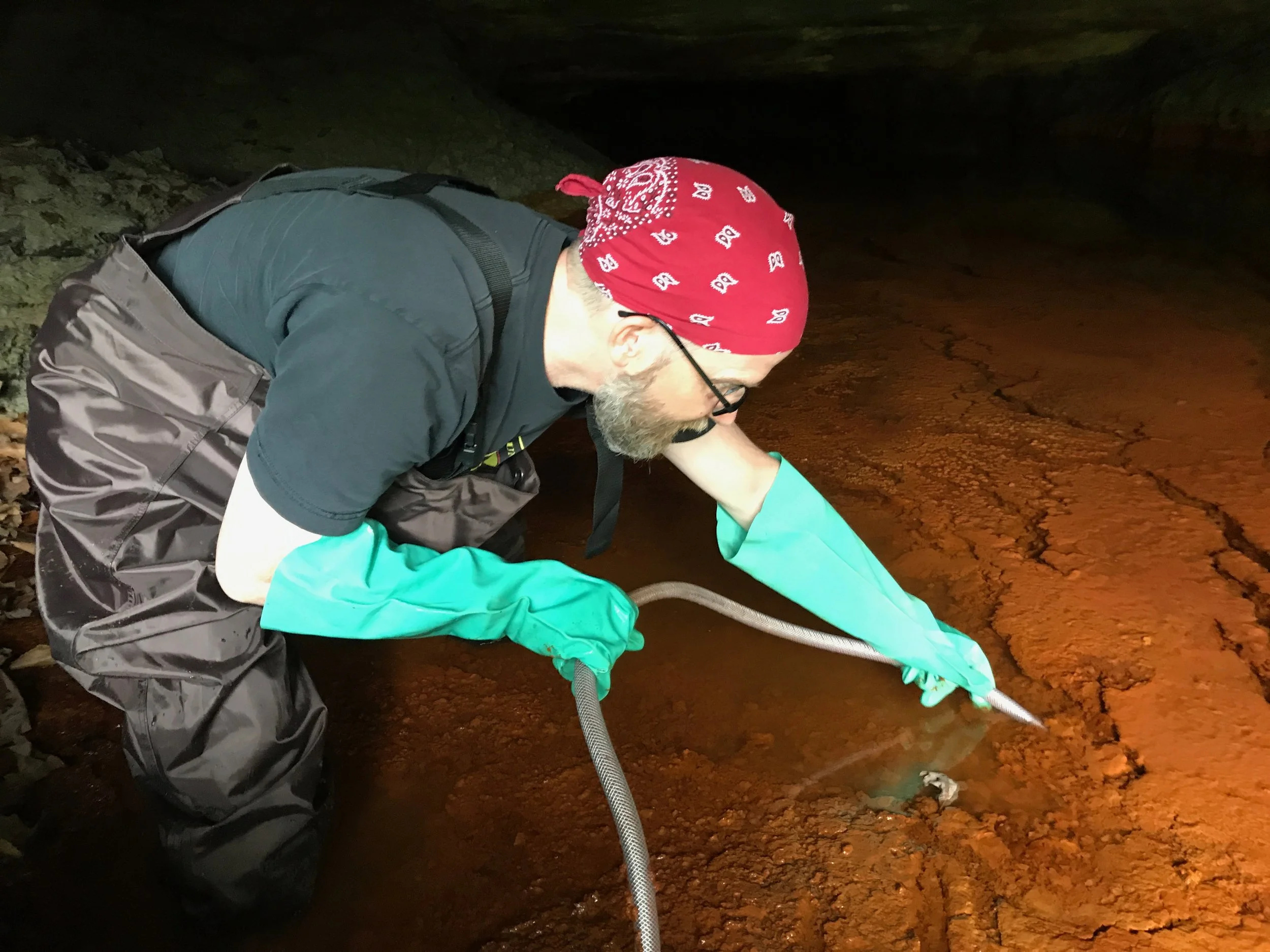
Acid Mine Drainage (AMD)
Sabraw has been working in collaboration with Professor and Chair of Civil and Environmental Engineering Dr. Guy Riefler, and Sunday Creek Watershed Coordinator Michelle Shively-McIver to develop pigments derived from a process of remediating streams from toxic runoff from abandoned coal mines, (called acid mine drainage or AMD). The sale of these pigments can pay for treatment operations and profits can be used for further remediation projects.
In Southeastern Ohio many of the streams run orange. Throughout the first half of the 20th century strip mining and room-and-pillar mining were common throughout this region. Forests were clear cut, soils scraped away, and tunnels dug to remove the coal. A few active coal mines continue in the region, but by the 1970s most of the mining companies had moved on leaving behind open mines and disturbed land, with inadequate restoration. These underground mines continue to release toxic water to streams. When abandoned, many of the mines fill with water, and the oxygen and water react with mineral surfaces that had been buried for 300 million years. When sulfides are present high concentrations of sulfuric acid and iron are produced. In one local seep, in Truetown, over one million gallons per day of polluted water enters Sunday Creek and impacts the next 7 miles of stream. This water has a low pH and carries over 6,000 lb. of iron per day. Professors Riefler and Sabraw started asking what if the iron sludge could be sold as a valuable resource rather than disposed of as a waste product? What if treating pollution could be an entrepreneurial endeavor rather than a societal cost?
Their collaboration has enabled these powdered iron minerals to be made into a working paint. Sabraw has developed a relationship with Gamblin Artists Colors who produces 37mL tubes of oil paint using three different AMD pigment colors. These “Reclaimed” paints have been distributed to artists around the world and many of their resulting artworks can be viewed in the educational gallery.
Our team, partnering with the Ohio Department of Natural Resources, is currently in design phase for a large facility to implement our process at the worst AMD pollution site in Truetown, Ohio. In just a few years our goals is to start a new industry in Southeast Ohio that turns pollution into paint, while restoring our watersheds.